SAP ECC end of maintenance 2027: what ends and what applies after


 @operayogmbh
At the end of 2027, mainstream maintenance for SAP ECC ends. That often gets repeated as "support ends in 2027", which is not accurate. SAP does not switch ECC off; maintenance is reduced in stages. Which stage applies to your system depends on your enhancement package, your contract, and whether you move to the private cloud.
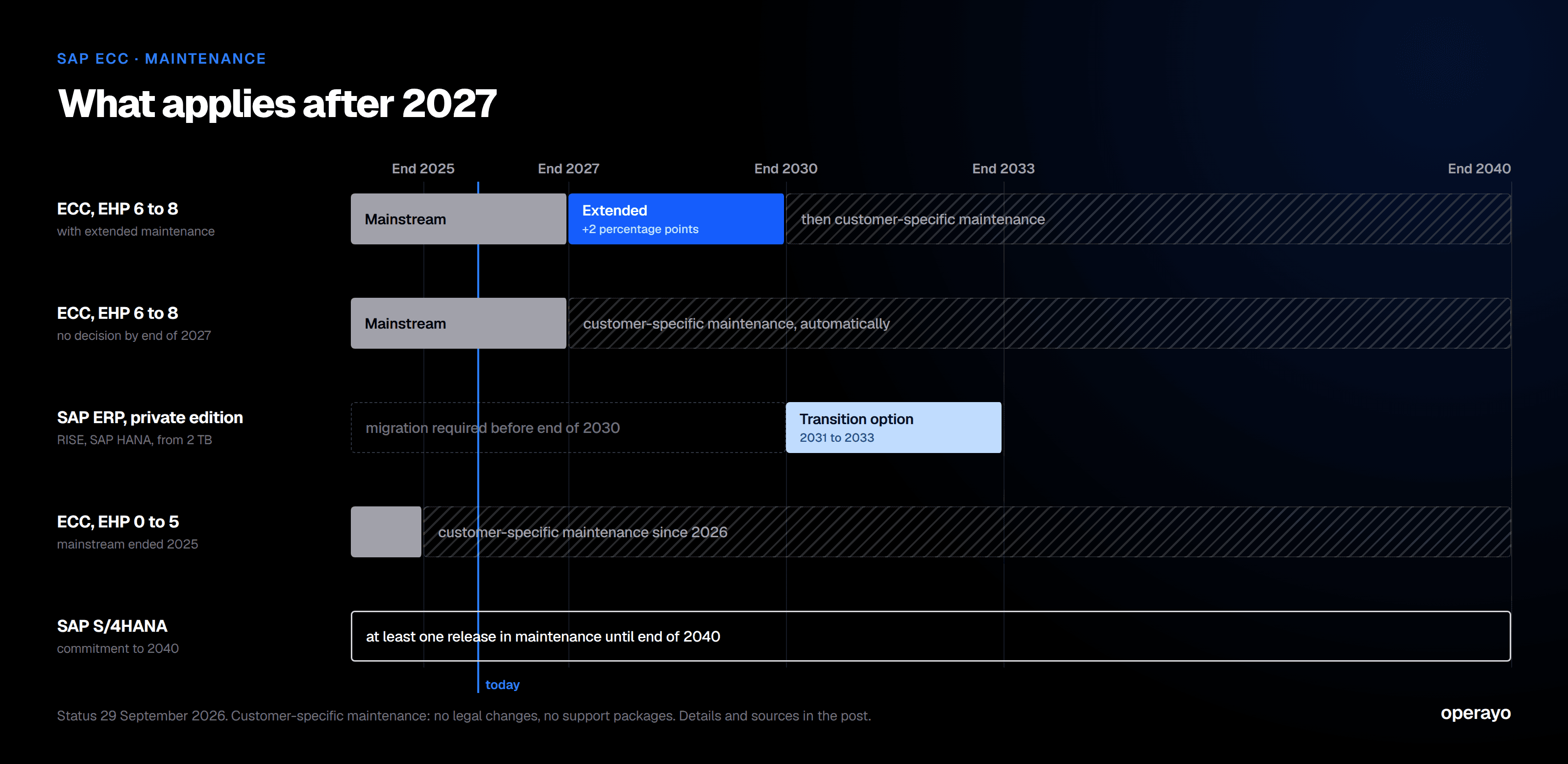
What ends in 2027
In February 2020 SAP announced mainstream maintenance for the core applications of SAP Business Suite 7 until the end of 2027. SAP counts SAP ERP 6.0 among those core applications, alongside CRM 7.0, SCM 7.0, SRM 7.0 and SAP Business Suite powered by SAP HANA.
For SAP ERP 6.0, the date of 31 December 2027 applies to enhancement packages 6, 7 and 8. EHP 8 is the last one, so there is no newer package to move to.
Older enhancement packages are already out
For SAP ERP 6.0 without an enhancement package and with enhancement packages 1 to 5, mainstream maintenance already ended on 31 December 2025. SAP's own maintenance strategy overview has listed them under customer-specific maintenance since then. If you still run one of these releases, you are already where many expect to be only in 2028.
The stages after 2027
Extended maintenance until the end of 2030
For EHP 6 to 8, SAP offers extended maintenance until 31 December 2030. According to SAP it costs a premium of two percentage points on the existing maintenance basis. SAP describes its scope as similar to mainstream maintenance.
The deadline matters. Customers who have not opted for extended maintenance by the end of 2027 and keep running ECC are moved to customer-specific maintenance automatically.
Customer-specific maintenance
Customer-specific maintenance continues at unchanged fees. You can still create incidents as usual, and SAP solves known issues. What falls away is set out in SAP Note 52505:
no delivery of legal changes
no support packages
no guarantee of technology updates, such as new kernel versions for new database and operating system versions
no support for new interfaces
no service level agreements for initial response times and corrective measures
This stage applies after mainstream maintenance ends when no extended maintenance has been taken, and likewise after extended maintenance ends.
SAP ERP, private edition, transition option
With the SAP ERP, private edition, transition option, SAP extends maintenance for ECC systems in the private cloud beyond 2030. The option is active from 2031 to 2033 and can be purchased from 2028. SAP explicitly calls it an additional, non-mandatory offering. It delivers patches for security, legal and software issues.
The conditions are narrow. According to SAP's August 2025 update:
Systems must be migrated to SAP ERP, private edition on SAP HANA before 31 December 2030.
The option is only available in combination with the max success plan.
Systems in scope must be at least 2 TB.
The scope centres on SAP ECC and does not cover the full SAP Business Suite 7.
Customers who sign up for SAP ERP, private edition in 2026 get a standard 20 percent uplift in pricing when they switch to the transition option in 2031. For sign-ups from 2027 onwards, SAP has not yet disclosed the uplift. There is no such option for ECC in your own data centre.
What this means in practice
Legal changes make the biggest difference. While mainstream or extended maintenance runs, SAP delivers adjustments when, say, tax rules or reporting obligations change. Under customer-specific maintenance SAP no longer delivers them, and implementing them falls to you or a partner.
The same goes for the technology. Without guaranteed kernel versions for new database or operating system versions, a necessary infrastructure update can hit a limit. The system keeps running; it just gets harder to move.
A note on the naming
Since 2025 SAP has used the name "SAP Business Suite" for a new offering that brings applications, data and AI together. It shares only the name with SAP Business Suite 7, whose maintenance this post is about. In documents and quotes it is worth checking which of the two is meant.
And SAP S/4HANA?
SAP has committed that until 2040 there will always be at least one release of SAP S/4HANA in maintenance. From SAP S/4HANA 2023, each release stays in mainstream maintenance for seven years, up from five. That is not a commitment for any one release to 2040, but it is certainty that the product line is maintained until then.
Where companies stand
The DSAG investment report 2026 gives an indication. Of the respondents planning investments in SAP ECC, almost half intend to move to SAP S/4HANA by the end of 2030, which puts them into paid extended maintenance. 37 percent want to move by the end of 2027, and 4 percent are aiming for the end of 2033 and therefore the transition option.
For context: 198 people took part in the survey, the figures refer to the subgroup planning ECC investments, and they are plans rather than completed migrations.
What to settle now
Which enhancement package are you on? For EHP 0 to 5, mainstream maintenance has already ended.
Will you take extended maintenance to 2030? The decision has to be made by the end of 2027, otherwise customer-specific maintenance applies automatically.
Which legal requirements come up after 2027, and who implements them when SAP no longer delivers them?
Is the route via RISE with SAP and the transition option an option for you? Then the migration to SAP ERP, private edition on SAP HANA has to be done before the end of 2030.
The details are governed by SAP Notes and your maintenance contract; the information here reflects the status as of 29 September 2026. If you want to sort out your route: our S/4HANA Architecture Assessment gives existing transformation plans a neutral review, whether greenfield, brownfield or selective migration.