Understand the SAP BTP licensing model before it gets expensive


 @sarahniesel
Most companies do not run into trouble with SAP BTP's technology. They run into trouble with how it is licensed and billed. The platform can do a great deal, and whether it pays off comes down to the licensing model. That is the part most teams find hard to see through.
Three models in plain terms
SAP offers three commercial models for BTP.
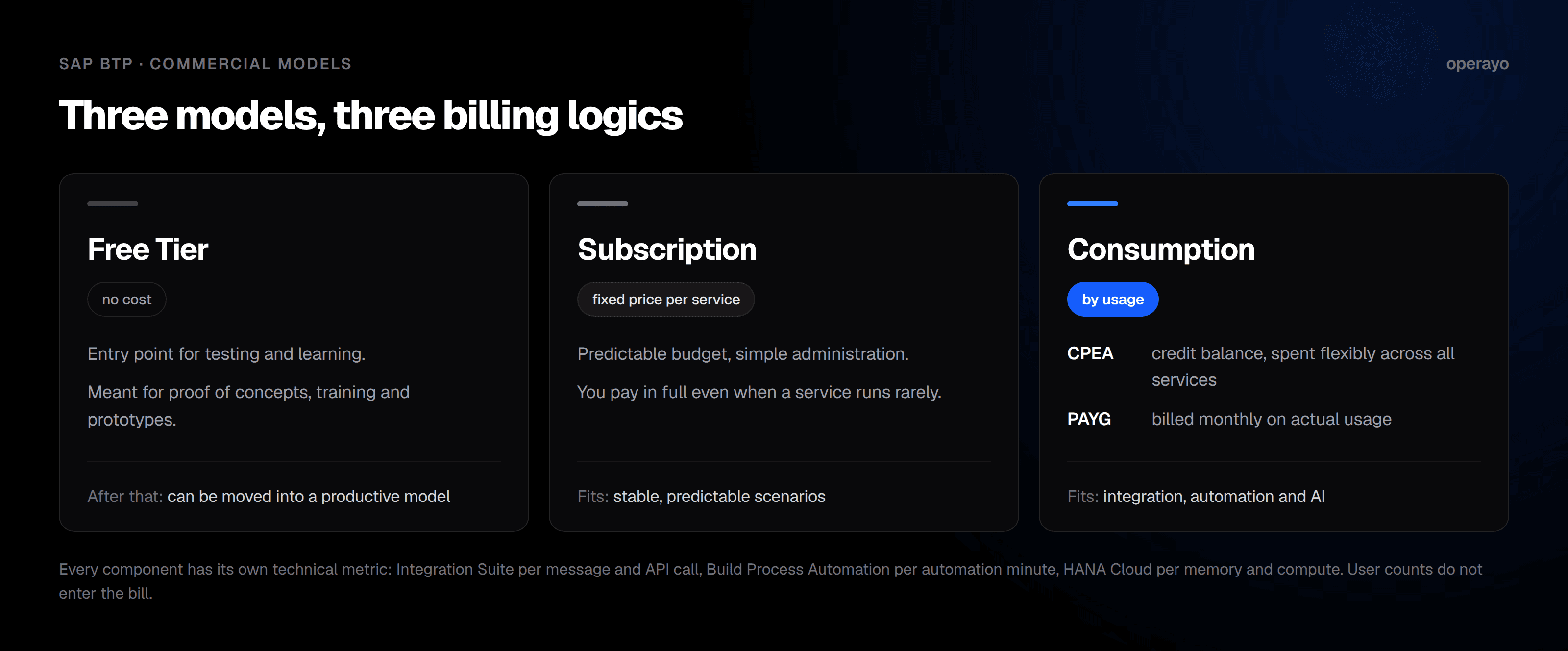
Free Tier is the entry point for testing and learning: no cost, meant for proof of concepts, training and prototypes. A Free Tier setup can be moved into a productive model later.
Subscription is the fixed-price model. You book a service at a fixed price, the budget is predictable and the administration is simple. The catch shows up when a service only runs occasionally. You still pay in full.
Consumption is the usage model, in two variants. With CPEA (Cloud Platform Enterprise Agreement) you buy a credit balance and spend it flexibly across all services. PAYG (pay-as-you-go) bills monthly on actual usage. Both grow with demand.
Why BTP works differently
One misunderstanding follows many projects from the start: BTP is not licensed per user. It is billed on technical metrics, and every component has its own unit. Integration Suite counts messages and API calls, Build Process Automation counts automation minutes, HANA Cloud counts memory and compute. If you do not know the metric behind a service, you cannot plan its cost with any confidence.
BTP becomes economical when the model fits the workload. The cheapest model on paper is rarely the cheapest in operation.
The expensive misunderstandings
We keep seeing the same patterns in projects. A proof of concept slides into regular operation without anyone revisiting the licensing model. A subscription keeps running although the service is barely used. And RISE or GROW contracts hold a BTP volume many customers do not know they have, while new services get bought alongside it.
Workload first, then the model
The order matters. Look at the workload first: what runs constantly, what fluctuates, where are the peaks? After that the choice almost makes itself. Stable, predictable scenarios fit Subscription. Moving parts such as integration, automation and AI fit Consumption, because they breathe with demand.
Three habits pay off here:
check consumption monthly instead of once a quarter
use up existing RISE or GROW credits first
review the licensing model once a year, because BTP changes faster than almost any other SAP product
Where this leaves you
The licensing model is not purely a procurement topic. It governs how far BTP scales in operation, which is why the question belongs in the architecture discussion and not only at the negotiating table. That is where we see our own role: between SAP's pricing logic and what an operation actually needs.