German e-invoicing mandate 2027: what changes for SAP customers


 @operayogmbh
On 1 January 2027 the e-invoicing transition period ends for a large share of German companies. Anyone with more than 800,000 euros of turnover in the previous year must then, as a rule, issue invoices to other domestic businesses as e-invoices. That is three months away, and in many SAP systems it has not been implemented yet.
What has applied since 2025
The legal basis is the Growth Opportunities Act (Wachstumschancengesetz) of March 2024, which rewrote the invoicing rules in section 14 of the German VAT Act. Since 1 January 2025, domestic companies must be able to receive e-invoices. According to the Federal Ministry of Finance, an e-mail inbox is enough for that.
The definition matters. An invoice only counts as an e-invoice if it is issued, transmitted and received in a structured electronic format that allows electronic processing. A plain PDF explicitly does not qualify; it counts as an other invoice.
What changes on 1 January 2027
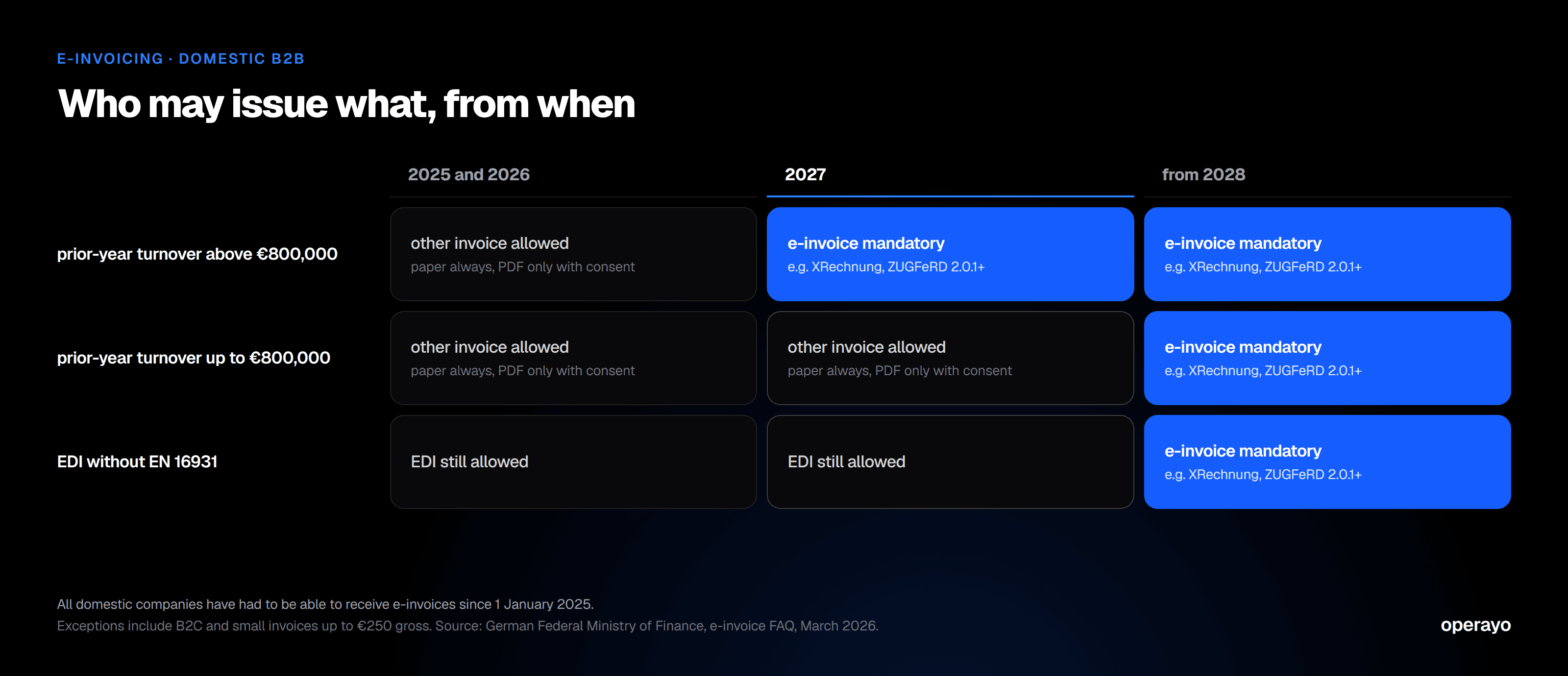
Until 31 December 2026, every issuer may send an other invoice instead of an e-invoice. Paper is always allowed, a PDF by e-mail only if the recipient agrees. After that the rules are staggered:
From 1 January 2027, the transition rule only applies to companies with prior-year turnover of up to 800,000 euros. For them it runs until the end of 2027.
EDI procedures that do not already meet the e-invoice requirements may also be used until the end of 2027.
From 1 January 2028, e-invoices are mandatory for everyone for supplies between domestic businesses.
What counts is the issuer's turnover in the previous year. So if you turn over more than 800,000 euros in 2026, the obligation applies to you from January 2027, unless you use an EDI procedure.
Which formats qualify
According to the ministry, the formats common in Germany, XRechnung and ZUGFeRD from version 2.0.1, meet the VAT requirements, with the exception of the ZUGFeRD profiles MINIMUM and BASIC-WL. Other formats, including EDI, are possible if they allow the correct and complete extraction of the details required under the VAT Act.
What is not affected
The ministry lists cases in which no e-invoice has to be issued, including:
invoices to private consumers (B2C)
small-value invoices up to 250 euros gross
tickets that count as invoices
supplies by small businesses under the small business scheme
supplies to legal entities that are not businesses
many VAT-exempt supplies under section 4 nos. 8 to 29 of the VAT Act
Input VAT and archiving
As long as an other invoice may still be issued, the ministry says it continues to count as a proper invoice for input VAT deduction. What applies in individual cases after the transition periods is set out in the ministry's letters of 15 October 2024 and 15 October 2025. For individual cases, your tax adviser is the right contact.
On retention, the ministry says invoices must be kept for eight years for VAT purposes, and for an e-invoice at least the structured part must be kept intact in its original form. A printout or a PDF generated from it does not replace the original.
What this means in the SAP system
On the outbound side, the system has to be able to produce invoices as XRechnung or ZUGFeRD in a permitted version, in good time before the date that applies to your company. For electronic invoicing and tax reporting, SAP offers SAP Document and Reporting Compliance, among other things. Which variant fits your release and operating model is an architecture question and worth settling before you buy.
On the inbound side, the e-invoice is actually good news. The data arrives structured and no longer has to be typed in or read out with text recognition. The work shifts to validation, matching against purchase order and goods receipt, posting, and archiving the structured original.
There is one limit worth knowing. The obligation covers invoices only. Delivery notes, order confirmations and payment advices are not included and keep arriving in whatever format the sender chooses, often as PDF. Processing those automatically remains a separate task.
The next step comes from Brussels
On 11 March 2025 the Council of the EU adopted the VAT in the Digital Age package, enacted as Directive (EU) 2025/516. It makes the VAT reporting obligations of companies selling to businesses in other EU member states fully digital by 2030. Setting up domestic e-invoicing properly now also lays the groundwork for cross-border business.
What to settle now
Is your 2026 turnover above 800,000 euros? Then the outbound obligation applies from 1 January 2027.
Can your SAP system produce invoices as XRechnung or ZUGFeRD from version 2.0.1, and not in the MINIMUM or BASIC-WL profiles?
How are incoming e-invoices validated, posted and archived in their structured original?
Do you use EDI procedures that do not count as e-invoices? Then their transition period ends at the end of 2027.
This information reflects the status as of 29 September 2026 and is based on publications of the German Federal Ministry of Finance.
Digitalisation does not end with the e-invoice. More than 40 document types are in use in companies. Some of them are still printed out and entered into the SAP system by hand. More about plico